Overview
We co-designed and built Co-Cog, an accessible iOS and Android app that lets people living with early-stage dementia check their memory and wellbeing between appointments, and gives researchers and NHS clinicians a traffic-light view of who may need support.
- Client
- KSS Research Consortium
- Partners
- Universities of Kent, Surrey and Sussex; NHS clinicians
- Who it's for
- People living with early-stage dementia or mild cognitive impairment, and their care teams
- Our role
- Co-development and in-person workshops, UX and illustration direction, app and back-end development
- Platforms
- iOS and Android (Unity), PHP back end
- In the app
- Wellbeing questionnaire, 3 memory tasks, read-aloud on every screen
Technologies
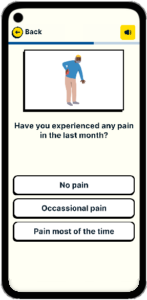
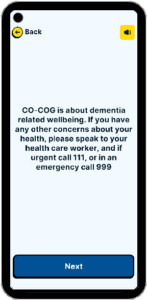
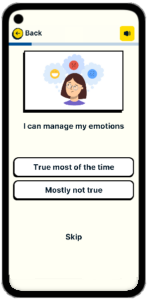
Questionnaire and safety screens
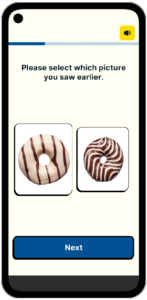
Memory tasks
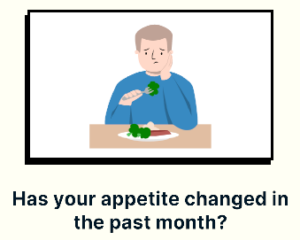
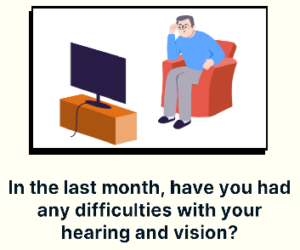
Illustrations
Testimonial
“I sort of forgot that you're contracted technology partners, and I felt like you're part of our team because of how you were involved in everything.”
Read the video transcript
My name is Nyangi Gityamwi. I’m a research fellow based at the University of Surrey, and I work within the School of Health Sciences.
In this project, we were interested to develop a tool that will support people living with dementia and mild cognitive impairment to monitor their health and well-being. The aim is to be able to pick up the need as early as possible for immediate intervention.
And we needed our technology partners who will be able to work alongside our target user—these are people living with dementia and mild cognitive impairment.
We came across Unusual Technology, and our initial conversation assured us that they would be in a good position to work with us and deliver what we’re hoping to achieve. We looked at their previous work and experiences and we were comfortable with what they’re doing, and we started working with Unusual Technology to develop this tool together.
They brought in some ideas, creative ideas that none of us members of the research team had. So we really appreciate that. Even though you don’t necessarily have expertise in dementia, you went the extra mile to think what could be appropriate to this group. Your patience and your flexibility that you put into the project.
Trust me, I do understand how challenging it can be and the unique demand of this group. We’ve gone through lots of meetings, back and forth, trying to modify the tool from beginning to the end.
You took the extra step of coming to these meetings. I don’t know whether this is expected, I don’t know whether in your previous work you went the extra mile to do this. I’ve never come across developers who are willing to be part of the team. So you were part of the team. At some point, I sort of forgot that you’re contracted technology partners, and I felt like you’re part of our team because of how you were involved in everything, in all these discussions.
You were offering your guidance, of course, your opinion from a technological point of view, but you were open to hear our side of need and to hear what is required from the users’ point of view. And that was important. That was really important.
And looking at how we were able to work together to achieve what we have achieved so far, I wouldn’t think twice to approach you to work together in another project.
The challenge
NHS teams supporting people with early-stage dementia have limited time for in-person appointments, so changes in someone’s memory, mood or health can go unnoticed between visits. Researchers from the Kent, Surrey and Sussex (KSS) research consortium wanted a tool that people living with dementia or mild cognitive impairment could use themselves, regularly, to flag when they need help as early as possible.
The users were the hardest part of the brief. The app had to be easy to use for people with memory difficulties, for people of different cultural backgrounds and physical abilities, and for people who are not used to digital technology, without feeling childish or patronising.
What we built
Co-Cog is a mobile app for iOS and Android with three parts:
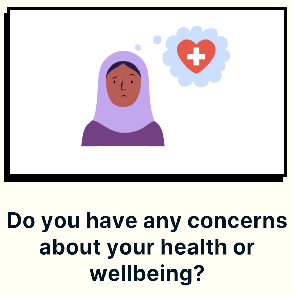
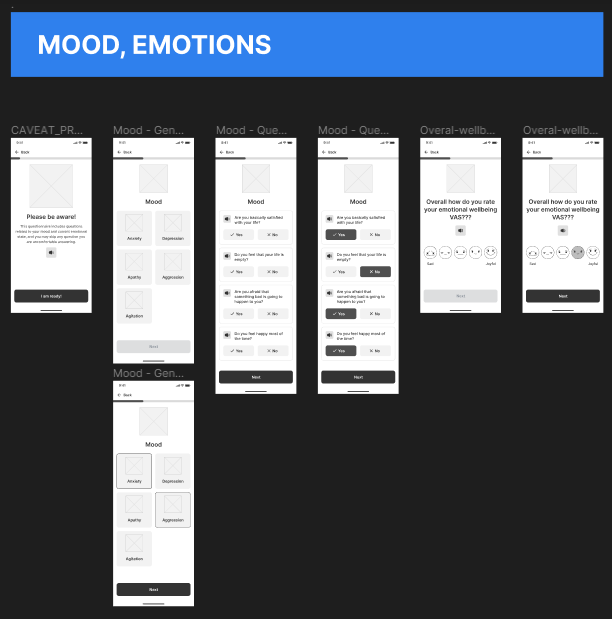
- A wellbeing questionnaire covering 12 areas, including mood, sleep, physical activity, falls, pain, medication, continence, appetite, and hearing and vision. Mood uses a visual analogue scale with faces.
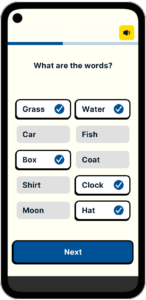
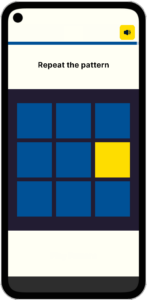
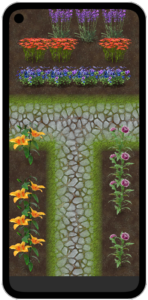
- Three short memory tasks: recognising a picture seen earlier (visual memory), recalling words from a list of 12 (verbal memory), and repeating a pattern on a 3×3 grid (sequence memory).
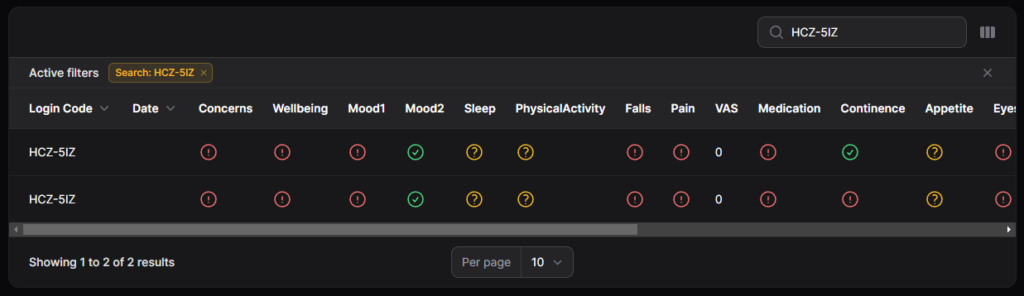
- A results dashboard for the research and care team. Each answer is shown as red, amber or green, so a clinician can see at a glance whether someone has changed since their last check-in and decide whether to arrange an appointment.
Users log in with an anonymous code rather than their name, and a safety screen points them to their health care worker, to 111 if it’s urgent, or to 999 in an emergency.
Designing for people living with dementia
We designed for accessibility in its widest sense: across cultural norms, mental and physical ability, and for people who didn’t grow up with digital technology.
- Every screen has a read-aloud button, a progress bar and a Skip option.
- Answers use a few large buttons instead of typing.
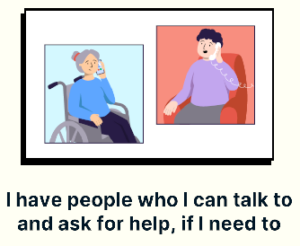
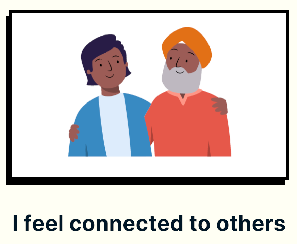
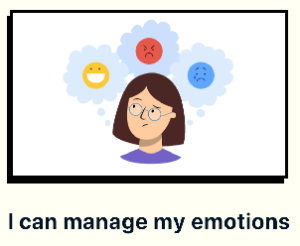
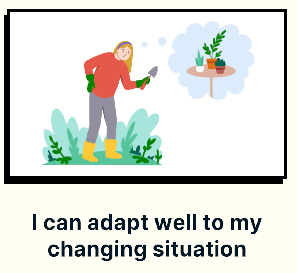
- Each question has its own illustration, drawn with an illustrator we worked with, showing what the question means. The illustrations show a diverse range of people.
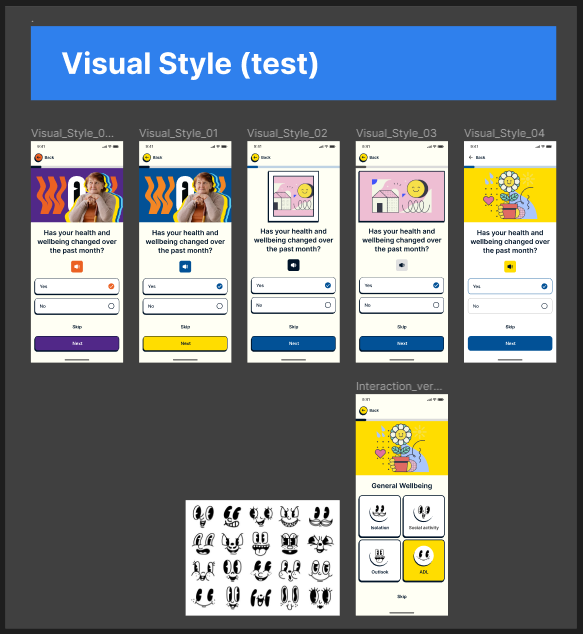
- We compared five visual styles in Figma, covering colour schemes, button styles and illustration styles, before settling on the final look.
How we worked
Co-Cog was co-developed with everyone it affects: the university researchers, healthcare professionals working in dementia care, and the end users, people living with dementia and their carers. We met regularly from start to finish and changed the app together.
We ran in-person workshops with people living with dementia and their carers. Working face to face with vulnerable people needs care as well as technical skill, and our team holds DBS checks.
Early on we built demos to compare a web app with a native mobile app, and tested questions such as whether to use typed answers or Next buttons, given how screen readers behave on phones. Later milestones refined the memory tasks, connected the app to a PHP back end that stores responses and calculates the traffic-light ratings, and finalised the questions and information pages. The finished app then went to an extended testing period with people living with dementia and their carers.
Learning a new field
We weren’t dementia experts at the start. As in every industry we work in, we learned the field from the people in it: the researchers, the clinicians, and people living with dementia and their carers. As the project’s research fellow put it, “even though you don’t necessarily have expertise in dementia, you went the extra mile to think what could be appropriate to this group.” That habit of learning a complex field quickly and building for it is how we work in healthcare and beyond.
Technology
| Part | Technology |
|---|---|
| App | Unity, built for iOS and Android |
| Accessibility | Custom read-aloud system, illustrated questions |
| Back end | PHP, storing responses and producing traffic-light ratings |
| Design | Figma wireframes and visual style tests |
Questions
Who was Co-Cog made for? People living with early-stage dementia or mild cognitive impairment, and the researchers and NHS clinicians who support them.
What does the traffic-light score do? It turns each person’s answers into red, amber and green results, so the care team can spot deterioration between appointments and act early.
Can Unusual Technologies build accessible apps with research teams? Yes. Co-Cog was co-developed with university researchers, healthcare professionals and the people who use it. See our other health and research projects for more.
Can your team work directly with vulnerable people? Yes. We ran in-person workshops with people living with dementia and their carers, and our team holds DBS checks.